The Plain-English AI Glossary

AI vocabulary changes weekly and most explanations assume you already know it. This glossary fixes that: every important term gets its own page, explained the way a sharp friend would explain it, and an automated scout adds the new words as they appear.
Start Aura Farming
Top AI money moves delivered every morning - free forever.
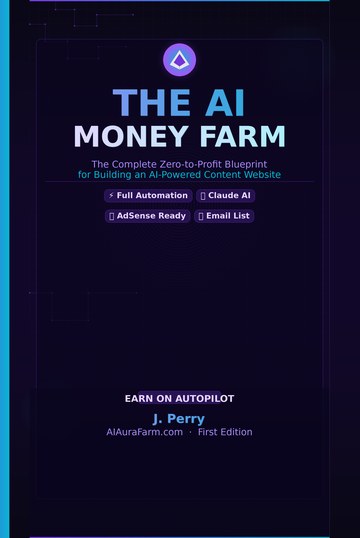
Want to Build a Site Like This One?
The AI Money Farm is the exact step-by-step blueprint behind AIAuraFarm.com.
Get It on Amazon →All Terms (69 and growing)
🎼 Agent Orchestration
Coordinating multiple AI agents to work together on complex tasks by managing their communication and workflow.
🌌 AGI (Artificial General Intelligence)
The contested finish line: AI matching or exceeding humans across essentially all cognitive work, and nobody agrees when.
🤖 AI Agent
AI that does instead of answers: given a goal, it plans, uses tools, and executes multi-step work with limited supervision.
🎯 AI Alignment
Making AI systems do what you actually want them to do, not just what their training technically allows.
🧠 AI Memory
The ability of an AI to remember and reference previous parts of a conversation within a single session.
🏆 Arena Elo
A rating system that ranks AI models by how often they win head-to-head matchups against each other.
📦 Batch Processing
Processing multiple requests together at once instead of handling them one-by-one.
📊 Benchmarks
Standardized tests that measure how well an AI model performs on specific tasks.
🤖 Browser Agents
AI that can browse the web, click buttons, and take actions on websites like a human would.
🧠 Chain of Thought
Making AI show its work by breaking problems into step-by-step reasoning instead of jumping to answers.
🧩 Chunking
Breaking long text into smaller, manageable pieces so AI can process and understand it better.
🤖 Computer Use Agents
AI systems that use tools and take actions on your computer to complete tasks automatically.
🎯 Context Engineering
Strategically structuring information you give an AI so it answers better and stays on track.
🪟 Context Window
The model's working memory: how much text it can consider at once, measured in tokens.
🎭 Deepfakes
AI-generated fake videos or audio that convincingly impersonate real people.
🎨 Diffusion Models
AI models that generate images by gradually removing noise from random static, guided by text descriptions.
🧪 Distillation
Training a smaller, faster AI model by having it learn from a larger one's outputs.
🧮 Embedding Model
A model that converts text or images into numerical lists that capture meaning, enabling AI to compare and find similar things.
✨ Emergent Capabilities
Unexpected skills an AI suddenly gains at scale, without being explicitly trained to do them.
🎓 Few-Shot Learning
Teaching an AI to do something new by showing it just a handful of examples instead of thousands.
🎛 Fine-Tuning
Additional training that specializes a model on your examples: powerful for consistent style and format, overkill for most needs.
🔧 Function Calling
Letting an AI call external tools or APIs to get real answers instead of making them up.
🎨 GANs
Two AI networks that compete to create realistic images, text, or data by trying to fool each other.
🖥️ GPU
The specialized chip that does thousands of math calculations at once, making it the engine behind training and running AI models.
🛡️ Guardrails
Safety rules built into AI to prevent harmful outputs and keep the system behaving as intended.
👻 Hallucination
When an AI states false information with total confidence: the single most important failure mode to understand.
⚡ Inference
Running a trained model to get answers: the phase you actually pay for, and the industry's great cost battle.
🔓 Jailbreaking
Tricking an AI into ignoring its safety rules to do things it's not supposed to.
⏱️ Latency
The delay between when you ask an AI something and when it starts answering.
🧠 LLM (Large Language Model)
The engine behind ChatGPT, Claude, and Gemini: a neural network trained on vast text to predict and generate language.
🎯 LoRA
A lightweight technique that tweaks AI models without retraining them from scratch.
🔌 MCP (Model Context Protocol)
The open standard that lets AI assistants plug into tools and data: USB-C for AI connections.
🎯 Mixture of Experts
A neural network that uses multiple specialist sub-networks, activating only the relevant ones for each task.
📋 MMLU
A standardized test that measures how well AI models perform across 57 different subjects, from math to history to medicine.
📋 Model Cards
A transparent document that describes what an AI model does, how well it works, and what it's bad at.
🎨 Multimodal AI
Models that work across text, images, audio, and video in one brain: point a camera at the world and talk about it.
🧠 Neural Network
A computer system loosely modeled on brain cells that learns patterns from examples instead of following fixed rules.
🧠 NPU
A chip built specifically to run AI math fast and efficiently, usually right on your phone or laptop instead of the cloud.
📱 On-Device AI
AI that runs and thinks directly on your phone or laptop, no internet or cloud server required.
🔓 Open-Weight Models
Models whose parameters you can download and run yourself: Llama, DeepSeek, Qwen, and the ecosystem of AI you own.
🎛️ Parameters
Parameters are the millions or billions of internal settings a model tunes during training to shape how it responds.
💾 Prompt Caching
Reusing AI's memory of earlier parts of a conversation to save time and money on repeated tasks.
✍️ Prompt Engineering
The craft of writing instructions AI models respond to well; less magic syntax now, more clear thinking.
💉 Prompt Injection
Tricking an AI by sneaking hidden instructions into your prompt to override its normal behavior.
📚 RAG (Retrieval-Augmented Generation)
The architecture that lets AI answer from your documents: retrieve the relevant bits, then generate with them in view.
🧠 Reasoning Models
AI models that work through a step-by-step thinking process instead of jumping straight to answers.
🎯 Red Teaming
Deliberately trying to break an AI system to find its weaknesses before users do.
👍 RLHF
Training AI by having humans rate outputs so the model learns what people actually want.
📈 Scaling Laws
The pattern that AI models get smarter as you feed them more data, compute, or parameters.
🎤 Speech Recognition
Technology that converts spoken words into text that a computer can understand and act on.
🌊 Streaming
Outputting AI responses word-by-word in real-time instead of waiting for the complete answer.
📦 Structured Output
AI output formatted as organized data (JSON, tables) instead of rambling text.
🧪 SWE-bench
A benchmark that grades AI coding assistants on their ability to solve real GitHub issues end-to-end.
🤖 Synthetic Data
AI training data that's artificially created rather than collected from the real world.
🎭 System Prompt
Hidden instructions that tell an AI how to behave before you even start talking to it.
🌡️ Temperature
A knob that controls how creative or predictable an AI's responses are.
⏱️ Test-Time Compute
Spending extra computing power during inference to get better answers, not just during training.
🔊 Text-to-Speech
Technology that converts written text into spoken audio using AI voices.
🎬 Text-to-Video
AI that generates videos from text descriptions, turning written prompts into moving footage.
⚡ Throughput
How many AI requests a system can handle per second or minute.
🔤 Token
The chunks AI models actually read and write: roughly three-quarters of a word each, and the unit you pay for.
🎯 Top-p Sampling
A sampling method that picks words from the most likely options until hitting a probability threshold, keeping outputs focused yet creative.
🧮 TPU
A chip Google built specifically to crunch the math behind AI, like a GPU's more specialized cousin.
🤖 Transformer
The AI architecture behind nearly every modern chatbot, it reads all words at once to spot connections instead of one by one.
🧭 Vector Search & Embeddings
Search by meaning instead of keywords: text turned into coordinates where similar ideas sit near each other.
✨ Vibe Coding
Writing code by describing what you want the AI to do, letting it handle the implementation details.
🎙️ Voice Cloning
AI technology that learns to recreate a person's voice from audio samples, then generates new speech in that voice.
🌍 World Models
An AI's internal mental model of how the world works, learned from experience to predict what happens next.
🎯 Zero-Shot Learning
AI tackling new tasks without seeing examples, using knowledge from training instead.
Why a Glossary?
Every AI conversation is full of words that gatekeep more than they explain. Each entry is a standalone plain-English deep dive: what the term means, why it matters, and the practical intuition professionals actually use. New terms are added automatically as the field invents them, which it does weekly, and an automated scout hunts for brand-new vocabulary so this page defines the new words first.
Start with LLM if you are new to all of this, then hallucination, the one concept that keeps people out of trouble.